
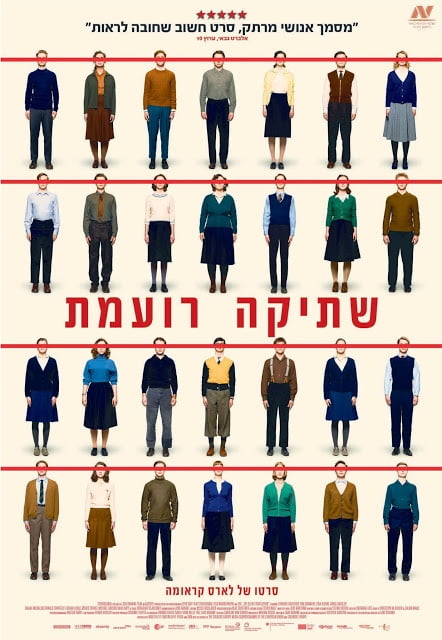
Bottom line:
Excellent movie,that allows a timeless experience concerning the importance of preserving the right of freedom of expression and freedom of thought,Especially now,While totalitarian regimes and crabble in democracies are part of the contemporary being.: Take your teens to 111 Minutes in German (With translation) of why it is important to preserve freedom of expression and thought.
Highly recommended and very important!!!

The year is 1956 And the place is East Germany..
“To the freedom of the peoples!” Says old gay Edgar,Freedom that too many times is taken for granted.
You probably have to be naïve enough to expect the regime to be honest and free..

With us this year is 2018 And the discourse is violent.,We understand that when the Minister of Communications is also the Minister of Defense.,Prime minister,Minister of Foreign Affairs (Or it's the Foreign Secretary.?)
The Minister of Health and the Minister in Charge of Immigration must be here a significant violation of freedom of speech and thought.,It's so expensive and fragile.,Who in every way tries to replicate his subjects to the rulers with maximum comfort,Which will ensure the continued existence of this regime.
Not in vain, the first thing Hitler did.,Upon coming to power,Was to take all the channels of communication with the German public,And in fact with the world,and monitor information and consciousness control en masse.
Freedom of thought is a danger to totalitarian regimes, and the film illustrates this well..

1956, during a sneaking into a cinema in West Berlin, Theo and Kurt are exposed to photos from the Hungarian uprising in Budapest. On their return to East Berlin, They manage to convince their high school friends to hold a spontaneous minute's silence in solidarity with the victims of the uprising.. This gesture hits waves far more than they had been forestad and the students become a political game in totalitarian East Germany. While the high school principal tries to rationalize the act as an act of youthful naughty, Education Secretary declares action an act of Mary. He demands to be named as the head of the rebellion., But the students decide to stick together., In a decision that will change their lives forever.
Trailer https://youtu.be/S3dSMg3vlPE
Auditions
Theo Lemke: Leonard ScheicherSource:WUCHTER: Tom Grantz Tom GramenzLena: Lena Kalanka Lena Klenke: Jonas Dessler Jonas Dassler
Paul: Isaiah MichalskiHerman: Ronald ZehrfeldIngrid: Karina Visa Carina WieseMar Schwartz School Principal: Florian Lucas Florian LukasFerau Kessler: Yardis Treble Jördis Triebel Secretary Ringle: Daniel Krauss Daniel Krauss: Michael Gwisdek Minister for People's Education Mr Lange: Burghart Klausner Burghart Klaußner Hans Wuchter: Max Hope Max HoppAna Wuchter: Yodith Engel Judith EngelMer Meltzer: Getz Schubert Götz Schubert
Creating
Director and screenplay: Lars Kraume Lars Kraume based on Dietrich Garstka's book Dietrich GarstkaPhoto: Jens Harant Production Design: Olaf SchleiferOlaf SchiefnerCostume Design: אסתר ואלץ Esther Walzעריכה: ברברה גיז Barbara Giesליהוק: נסי נסלאואר Nessi Nesslauerהפקה: Miriam Dossel, סוזאנה פרייר Miriam Düssel, Susanne Freyerסרטי אקצנטה Accents Film & Fernsehproduktion
Germany 2018,111 subtlety, German, Subtitles for Hebrew and EnglishStarting from date 27 December at the Tel Aviv Cinematheque and throughout Israel
Distribution in Israel - Nachshon Films Is a true story about a dramatic Cold War-era event. Based on Dietrich Garstaka's personal experience and story, One of – 19 Students who turned all educational institutions in East Germany against them, Following one human action, Lars Karuma., Award-winning director, (Between them., German Film Award in 2014 2016 For “The Truth of Fritz Bauer”), He has teamed up with a group of leading and talented young actors in German film and theatre alongside well-known and established actors.
Introduction by the author of the book Dietrich Garstka“Let it all go, Just let history be history”.There were a lot of people who said similar things., And a lot of people who saw what really happened. Young people who opposed the authorities and without planning any kind of insurgency simply integrated into the insurgency, You could say. However, as soon as they got to the bottom of things, they began to act in full force.. Young people who left their mark because they were angry, And with that anger that's so unique to young people, they acted against what they saw as the taking of freedom., She recognized the power of the story.. Lars Karuma director, See this, He was able to grasp the politicization of their behavior., With all the lightness of his youth, he was able to present a snapshot showing how the class grew together under the heavy pressure of the state apparatus.. It came as no surprise that this story became a movie.. Since the book was published, Of course, I was a little worried that I wouldn't be able to accept that the movie had a slightly different dramaturgy.. But in light of the result, I'm very glad this movie was made.. The whole time I was watching the movie, I said to myself, “Uh, Yes, That's how it was., That's how it happened.”.The memories came back to me and re-observed and the emotions are exactly the same feelings I felt 60 years ago.. Rejection that has become a contempt for people's idealism, Contempt for the fact that even for schoolchildren, the thinking was whether they were for or against the government.. They'd ask. “Are you for or against peace??” The meaning has always been, Are you for or against the German Democratic Republic? (The official name of East Germany then). When I watched the scenes, The fear of those days is back.. The fear that the Minister of Education, That he has the power to destroy an entire class will betray you again.. I felt the sense of threat very strongly., Because the film tells of the events when it uses a very tangible language of imagery. It's all told without distorting things., Very clear on his line, Very objective. Yes, That's how they act., That's how they acted., Dictators who were not afraid to act in their home against young people and took them very seriously as a threat to their power. Were in no way able to forgive their protest, Because they were stuck in their ways of thinking, and they wouldn't allow any change.. The atmosphere at the time was of joy of life on the one hand and a threatening tension and fear on the other.
Conversation with director Lars Kraumash: How did the idea come up for a movie??Tel: A producer friend of mine gave me Dietrich Garstka's book eleven years ago.. After five years I found the idea of how it could be processed, But in the meantime, the rights have already been sold., of course. They were in the hands of Miriam Dossel and Acasante Films.. Luckily they didn't have a screenwriter., So I introduced them to my idea of a script., And from there we began to move forward..That: Why you wanted to tell this story from the history of East Germany?Tel: While I was interested in this book, I started working on the movie. “The Truth of Fritz Bauer”. I was at the point where I asked myself what life was like in Germany after the Third Reich.. Both films explore the question of a country in a state of madness.. The question was how Germany tried to find its way from terrible history to a new future.. East Germany was on one lane., West Germany on Monday. Both attempts were difficult., That's what I'm trying to show in both movies..That: How long does the investigative process last for a movie?? And where and how you did the debriefing?Tel: Research and writing always work for me at the same time.. I read and write, And then there's nothing else I can do.. And I'm starting to re-read. The basis is the story of Dietrich Garstka.. It's such a dramatic story that it's usually told differently by each of those involved in the event.. But if you get too many approaches to the same story, it's going to be hard to develop a credible consistent storyline.. That's why I only spoke to Dietrich exclusively.. About his book and what he remembers from that time.. And I've also watched a lot of movies from that time.. Especially “Berlin, Corner of Shaunahauser” Shot at the same time as our movie is going sniffing around, And in the movie, too. “Carla”, Banned for screening in East Germany at the time, It was very important to me to paint an authentic picture.That: How can you describe the social background of that period”Thunderous silence” Number on it?Tel: You always have to remember that the movie takes place in the town of Stalin-Staat in 2008. 1956. The Berlin Wall has not yet been built and there was faith and hope that socialism is a supreme and good form of society from capitalism that can be justified. Clearly, we didn't want to showcase the grey image of East Germany.. Which is why we transferred the footage from Strokov to Stalin-Staat, now called Eisenhowenstadt.. This model city was very modern in 2008. 1956. Established as a working city alongside the steel industry. She offered her residents conditions., Workers living in the Ruhr region of west Germany could only have dreamed of them in those years.. What was similar between east and west was the bond of silence about war., and the connection of different people to that period and to the Nazi Party and to war crimes.. People's inability to deal with their past is also an important element in the characters in the film..That: What role do you think the Hungarian rebellion played in 2012? 1956 East Germany?Tel: The uprising in Hungary was possible because Khrushchev changed the political direction, After the end of Stalin's reign of terror. First in Poland and then in Hungary people felt safer and demanded more freedom and rights. The Russians' desire to release a little didn't go that far.. After all, the West used the Hungarian uprising for its propaganda and needs.. And in the East, they tried to minimize the magnitude of the damage with their own propaganda.. Big, This insurgency was more important to people in the East than to observers from the west.. These dealt with the crisis in the Suez Canal and with other political events that seemed more important at the time..That: How do you see the broadcasts on both sides at the same time?, In the context of fake news and the creation of public opinion?Tel: Fake news is propaganda. The mechanism is similar in both places. The truth is distorted and then conveyed as propaganda.. And then everyone talks at the same time and believes what they heard.. It doesn't matter if you call it fake news or propaganda., The responsibility is ultimately in the hands of every person to turn their head on and think. If all you do is program the other people's thoughts, You have a problem.. It's true that it was harder to find different sources of information on the same subject in those days of the Cold War., And that refers to both east and west.. Today it is very easy to generate thought and opinion, On the other hand, it's easy to check the news and not believe every tweet..That: What it was like to process real events to the screen right after “The Truth About Fritz Bauer”?Tel: Both films come from my interest in the development of my country after the war.. Both films are political drama.. The challenge as a screenwriter who processes true stories is to find the right balance between historical accuracy and dramatic intensity.. Nobody likes to come out of the movie theater and say, “Everything was real but it was boring” And no one wants to hear after a movie screening that the truth was completely different.. It does take a lot of effort., But it's great when it works.. I'd definitely rather watch movies based on real events than watch superhero movies.. I don't think there's anything more inspiring about cinema than different people's actions..That: Even though you made a historical film, Some scenes have a sense of timelessness., And it seems they could have happened nowadays.. Was the idea of giving historical events a universal dimension?, And how do you see the context for political events of our time?Tel: I think historical films have to be relevant today.. In this case, the statement that everyone must be a political person at some point in their youth. There's no way around it., Not then and not today.. If you don't have an opinion you're sticking to, you've got nothing..That: How much of the story is made up? How do you deal with historical events as a director?Tel: It was my job to find the general in writing history., In Garstaka's story, where he goes into a lot of detail, it's very close to the truth and what happened to the characters.. I changed the background a little bit., Their families and the place where it happened.. As a director it's a pleasure to make historical films because you can create a whole world. If you're making a movie with a documentary background, you always have to face the ugly reality.. Today you always have to have some orange recycling bin, Ugly city bus, And people in yellow raincoats. Photography is a great pleasure Writing is hell.That: How did you find Eisenhower to shoot there?. What was it about her that made you decide to shoot there??Tel: Finding this town is very lucky., A 1950s model city that is the largest monument in Germany, To these cities, We could have taken pictures all over town.. Usually something like this is possible if you have a Hollywood budget. We just needed a lot of extras.. And this is where the nice open-minded townspeople came towards us., They've come forward to serve as an ass., Stand for hours in winter cold and period clothes and with great patience. We were also able to take pictures in the steel mills and give them periodic shape. Shortly after filming, these factories were closed., Even though they've been operating since 2008. 1951. We arrived just in time in that respect.. Filming has become a historical testimony in their own right.. And the most important discovery in this city is the school building., which is today the documentary center and the Museum of Life in East Germany. Right next to a kindergarten that just closed down and allowed us to build the filming area there. In general, this town is not only attractive and interesting as an issue., But it's also interesting in terms of what's in it.. It reflects the optimism and hope that was in East Germany at the outset..That: Many of the adult actors were born and raised in East Germany.?Tel: It was the producer's idea that all actors who make teachers and parents would be those who grew up in the East.. One of them is unusual, but most actors create characters that relate to what they saw when they were kids..That: How the young actors prepared for their roles, Characters from a time so far away from them?Tel: They had boogie lessons and they had to read the book and watch east German movies.. The most important movie for them as it was for me, He “Berlin, Corner of Shaunahauser”. A film released the same year our story takes place that deals with rebel youth. They had a lot to look at., And like I said before., Another remedy was the film. “Carla” Banned from screening in East Germany and dealt with teacher and students from her graduation. For them, it was time travel.. They also worked alone., I can tell the actor Jonas Dessler went to the concentration camp in Zessenhausen., Because the camp has an important part in his family's history..The historical backdrop to the Hungarian uprising B- 22 October 1956, Students from the University Institute of Technology in Budapest write a letter demanding freedom of the press, Free speech, National Liberation, Free elections and withdrawal of the Russians. During nonviolent protests in- 23 October 1956 Government forces fired at demonstrators. A move that led to a lot of outrage and protests across the country.. B- 1 November 1956 After a long series of protests, Hungarian Prime Minister Emer Nagy announced, who had a vision of reforms and changes, On Hungary's neutrality and its retirement from the Warsaw State. Declaration of independence brutally suppressed by Russians. B- 4 Soviet forces entered Hungary in November.. 2500 Hungarians killed, and- 200,000 Others exiled. Those who refused to be deported, Imprisoned and sentenced to show trials and executions. The popular uprising was denounced as anti-revolutionary in all countries under Soviet influence.. In the West, the uprising was called “Struggle for freedom”.
ClassMid-1950s, Finalists at the Kurt Steflauer School in the town of Strokov in the Brandenburg area faced final exams in the hope of continuing at one of the universities that will choose East Germany. After hearing in- 24 October, On the radio station that was broadcasting from west to east and listening to it was forbidden and was done underground, That the footballer is revered for, Hungarian national star Franz Pushkash killed during popular protests in Budapest, Spontaneously decided to announce a minute's silence in his memory during a history lesson at- 29 October. The teacher who was very angry reported the incident to the school principal.. The headmistger tried to downplay the intensity of the incident, referring to it as a playful act by schoolchildren. But party members learned of the incident through school staff.. When things got to Fritz Lange's ears, Minister of Education of the Republic of East Germany, He threatened to expel the students from school unless they ratted out the protest organizers.. The boys stood firm and refused to cooperate., Refused to extradite the organizers even after investigations and extortion attempts by the authorities. They were all expelled from school in 2013.- 21 In December, they were prevented from accessing final exams at all schools in East Germany.. The class managed to escape East Germany, A move that was illegal in 2013. 1956 But it's possible at the time before the wall was built..EscapeFirst to escape was Dietrich Garstaka in- 19 December 1956, As the pressure on the students increased, he boarded the early train from Strokov to Berlin, Koenigs-Westerhuzen station., And from there he took the city train from East Berlin to the west.. He was granted political refugee status because he was politically persecuted by the authorities. The rest of the classmates fled east and west Germany between 25 To- 31 December. Except for four girls in Gisela., Ursula, Gertrude Walterout who wanted to stay in Strokov or at least East Germany for various personal reasons. The other students fled in small groups so no one would run alone.. All recorded in West Berlin. And- 7 January 1957 Go to Benghatras in Bansheim in the state of Hesse, There they graduated and won their diplom.About director Lars KarumaNative 1973, Worked as a consultant at an advertising company and a photographer. Between the years 1994 Until 1998 Studied at the Berlin Academy of Film and Television. The first film he produced won a prize at the International Film Festival in Turin Italy, His final film earned him the award at the Grammys. 2001 “Victor Vogel, Advertising Man”, Comic satire on the media world, He was followed by films for television including an episode of the hit series “Tat-Ort” (The murder scene). in the year 2005 Screened as part of the Panorama at the Berlin Film Festival “No songs about love”. B- 2006 His film earned him “Good morning, Mr. Goeta.” Directing Award in the Television Broadcasting Competition. Over the next few years, he made a name for himself as the director of the series. “Tat-Ort” Directing earned him awards and nominations. “The Truth About Fritz Bauer” Premiered at the Lucerno International Film Festival Switzerland. The story of the German-Jewish prosecutor who persecuted Eichmann despite much opposition and initiated the second Auschwitz trials in the 1960s. The film won the audience award at the festival and a variety of other awards: Hesse Prize, Bavarian Film Award and – 6 Lola Awards (German Oscars), Among them is the Directing and Screenplay Award for Lars Karuma. In his next film “Family celebration” Since 2015 Germany's best players performed, Some continued with him to the film. “Thunderous silence”. He processed Ferdinand von Schierch's play “Terror” (Currently on display at the Cameri Theater) Tv. The live adaptation earned him the German TV Award for Best Director.
Read the article on the site
OkkaOkka Inspired Fashion