
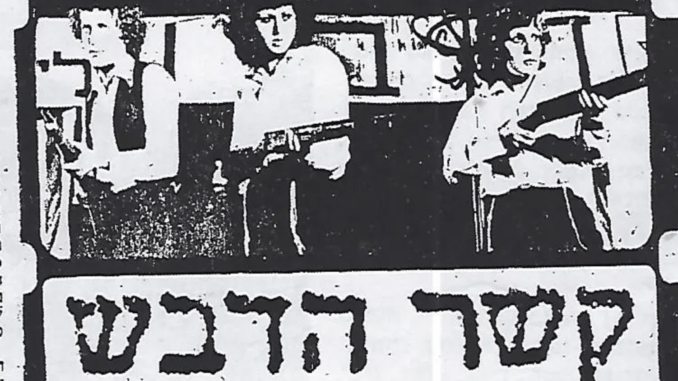
today, When the public is concerned about the empowerment of extremist elements in Israeli society, It's time to recall a short film from 1976, who predicted the establishment of an extremist Jewish underground, and the political violence of extremist elements in politics against the moderate public, Years before it happened in reality. The film "The Honey Knot" by Yazon Levanon and Aryeh Krishek.
System

January 1977 An unusual and unique film was released for a very short time, who described a serious security affair of a murderous Jewish terrorist underground called Debash, Acronym for "Third Temple Generation". Premiere, January 3rd 1977, Designed to collect money to pay debts from making the film. This screening was enough to cause a public outcry and then the film was dropped, And more than 12 years passed before the film was screened again in commercial screenings at the Tel Aviv Cinematheque.
This film was "The Honey Knot" from a script by director Yaoud Levanon and writer Arie Krishek, Produced by Ron Frankel, and directed by Lebanon Mission, Cast Gedaliah Besser, Galia Yishai, Moni Moshonov, Hanna Laslo, And Yiftach Katsur. who made a film the length of 55 subtlety.

The film is a political crime thriller set in Tel Aviv, and deals with a Jewish underground movement that murders a playwright like Hanoch Levin (Played by Isaac Hezekiah), After the latter staged a play in Jaffa called "The Honey Knot" which deals with an imaginary underground and mocks its activities. This turns out to be very irritating to the underground which is definitely real. Members of the underground break the club's windows at every screening, And the underground puts pressure on the playwright not to present his play.
After the show says actress (Hanna Laslo) That she fears being portrayed as a leftist, and actor (Moni Moshonov) "I'm not a politician and I don't understand politics, I'm a theater actor." – Kat. Police arrest young man (Yiftach Katsur made his film debut before becoming famous as the star of the "Eskimo Lemon" films), who admits to breaking into the playwright's apartment and accidentally killing him.
Gradually, however, a journalist investigating the affair discovers (Gedaliah Besser) That it was political murder. An attempt to silence the victim after discovering the existence of the underground, Led by two men wearing skullcaps – the spiritual leader (Hillel Namu), And the practical leader on the ground (Ezra Kafri), Based on the realistic characters of Gush Emunim leaders Rabbi Levinger and Hanan Porat.

The journalist witnesses the transfer of weapons by members of the underground from Villa in Herzliya Pituach, belonging to a well-known industrialist, To Arms Depots in Judea and Samaria. It is captured while watching, Captivated, And battered. After his release, the leaders prove to him that the gun is legal, And they show him a permit from the Ministry of Defense to carry it. This weapon, They explain, We need a march.
The journalist is determined to publish the story in his newspaper, and members of the underground, Among them is the industrialist and a senior police officer, Threatening to file a libel suit against the newspaper. At the end of the film, the story was disqualified for publication by the censors, Sabotage is carried out in the journalist's home, And members of the underground remain free.
In the chilling finale, it turns out that the Jewish underground has connections even at the highest levels of the police and even the press, by means of which they silence the affair. The underground conspiracy takes over society, Also through the arms of the law. At the end we see members of the underground sitting in a club and listening to a cabaret with their own songs.
The film is clearly influenced by American thrillers of the mid-1970s, who often described various conspiracy scandals that reach the highest levels of government. This followed the Watergate scandal, following which US President Nixon was impeached. Indeed, Director, Lebanon Mission, Began thinking about him while in Hollywood, And watch conspiracy films made in the US. But he said he was also influenced to an extent by political events that took place in Israel in the 1970s, Like the settlement of Sebastia and the establishment of Gush Emunim, Organized in the style of an underground in every respect. As well as the violent demonstrations against U.S. Secretary of State Kissinger in 1975 when he proposed a political solution to the conflict with the Arabs, and Rabbi Levinger – the spiritual leader of the underground, Played by Hillel Ne'eman with black-rimmed glasses similar to Levinger's, Based on him – who stated that "the law of the Torah is above the law of the land.", and the forgiving attitude that Israeli society had to these phenomena, As characterized by Yitzhak Rabin's declaration that "they are just a scout movement.".
All the creators and participants in the film engaged in it really voluntarily. They felt that this important issue should be raised.
The film reached first place in the Israeli Short Film Competition 1977, In the category of feature film longer than 25 subtlety (Together with the film "Nahum Glickson – Two Weeks in Israel" by Ethan Green), But it also came in first place in protests and condemnations from right-wing elements. Songwriter and composer Naomi Shemer, In the weekly bonfire "Shabbat" in the Davar newspaper, Defined it as a "blood libel against members of Gush Emunim".
Also because of its short length it was screened only a few times – at the Tzavta club, at the Cinematheque, And a short segment of it was shown on television in a program about films that won prizes in competitions, And disappeared. The film was disqualified for television screening after Hanan Porat and Zvi Slonim (He has since been suspected of ties to the Jewish underground) They threatened to appeal to the High Court of Justice against its screening. An excerpt of it was finally shown on the debate program "The Third Hour" hosted by Yaron London on the subject of "Jewish terrorism", In which the film's director Yazon Levanon participated together with Gush Emunim leader Hanan Porat – arguably one of the characters in the film, played by actor Ezra Kafri, Based on it, Including in the form of speech.
The film was originally filmed in 16mm, Only suitable for projections on home projectors and not on the cinema screen, and was not shown on television except for a segment as stated, But it was screened in kibbutzim and sparked many discussions.
The segment that was shown on television also received harsh reactions in the press, of Naomi Shemer and of writers Hanoch Bartov and Aharon Magd, They claimed that an affair like the one depicted in the film would not be possible in reality.
Unfortunately, as we know, they turned out to be wrong. Such an affair is certainly possible and even took place in the 1980s, Parashat The Jewish Underground You could say the film predicted. And there are those who would argue that similar things are happening in the present in which these things are written. What's in 1976 It could only exist on a satirical plane – a movement called the Third Temple Generation, that aspires to seize power, In the meantime, it deals with internal terrorism against "traitors" – has become a symbol of an entire group that aspires to establish the Third Temple, no matter what.
The film was screened again in 1989 at the Tzavta Club in Tel Aviv, Accompanied by a dialogue on Jewish terrorism, And its creators claimed that it foresaw the activities of the Jewish underground in the 1980s.
The film also served as the first harbinger of the wave of "leftist" films about the secret services in the 1980s, andSee my article here.
Later, excerpts from "The Honey Knot" were incorporated into another film of the Lebanese mission "119 bullets" + Three" – a 1996 documentary about far-right groups in Israel., And maybe intentionally ,As the "reality" version of the "honey knot".

The film, Mostly filmed before Rabin's assassination but edited after Rabin's assassination, Follows far-right movements from the massacre at the Cave of the Patriarchs to Rabin's assassination with a sophisticated combination of excerpts from The Honey Knot.
The title of Lebanon's documentary mentions the 119 The bullets fired by Baruch Goldstein during the massacre in which he murdered 29 Muslim worshippers at the Cave of the Patriarchs, as well as the three bullets fired by Yigal Amir when he assassinated Prime Minister Yitzhak Rabin.
Lebanon's film, His filming began about a year and a half before Rabin's assassination, Opens on the evening of the assassination and moves back and forth in time. The film presents the days after the murder and the country stricken with shock and mourning. Alongside this are the footage taken about a year and a half earlier, which include documentation and interviews with the leaders of the extreme right in Israel and the leaders of the Jewish underground, Among them are Yehuda Etzion and Hagai Segal, which Lebanon held in an attempt to see if there was a danger of civil war in Israel. As mentioned, the film also incorporates excerpts from Lebanon's political short film "The Honey Knot" (1976), which dealt with the question of the existence of an extreme right-wing underground organization operating in the shadows.
The film was screened at many festivals around the world, These include the Berlin and Hong Kong festivals, It was exhibited at the Museum of Modern Art in New York and won a special prize at the FIPA Festival in Biarritz, France. Due to the explosive issue, no distributor or broadcaster was found to present it in Israel.

Arie Krishek, who rewrote the script with the purpose of Lebanon, Says about him today: "I'm proud of making the film, It was very important to do it – and history has proven it.".
Krishek and his friend Yazon Levanon were part of a group of creative friends who dreamed of cinema and theater, Put on plays in a dramatic circle, and film in 16mm. The group included, among others, Eyal Bartonov, Micha Levinson, and Roni Frenkel z"l, who served as producer of "The Honey Knot". And finally they formed the "honey knot" together.
Krishek: I was mobilized politically. We were among the first young people to see the danger of the rise of the extreme right, And we decided to do something. The model was the thrillers of Costa CBRess And we went to do a Brechtian exercise with a cabaret element of honed political satire. I composed five choruses for the film, And most of the actors, Like Moni Moshonov and Hannah Laszlo, Volunteered. This is rare, They understood the importance of the matter. Almost everyone involved in the film worked voluntarily. The responses were very good, Although it was not traditionally screened. No one wanted to take it and screen it. It was a brave scenario because no one dared to speak out against Gush Emunim until then.
The film materialized – in a big way – into the Israeli reality: Armed underground movements; Armed and impassioned right; And as is well known, there were terrorist attacks in the West Bank; Youth of the Hills; Temple Mount Trustees; And more.
Alas, As is usually the case in history, the wake-up call we made didn't really help. The extremism has gotten worse and who knows where else things will go.
There is no doubt at all that reality has already exceeded the severity of the film. At least once, Disengagement, We were on the brink of civil war.
Even, Israel 2022 It is a much more violent and extreme place. I'm afraid it will only get worse.

So much for Krishek.
Today, unfortunately, "The Honey Knot" is no longer as sharp and shocking as it was for viewers in 1977. It's less harsh than any news we see every single day.
But it is worth remembering.. He watched today's newscasts. Today, unfortunately, the reality depicted in the film is extremely realistic, and the successors and successors of that movement, who speak openly about their desire to gain power, They have a growing grip on large parts of the public and are liable to seize power, And who knows if not to start a bloodbath.
"The Honey Knot" can be viewed online today, Having been unavailable for many years. Director Yaoud Levanon managed to find a complete copy of it and posted it online, And here it is again available for you to watch.
"The Honey Knot" in the Israeli Film Archive Jerusalem Cinematheque
And as a bonus :Here are two newspaper articles of the 1980s about the "honey knot".

Hannah Kim's article on the "honey knot" published in the "Seal" supplement of Al HaMishmar in 1984
Go to read the article on the website "Cultural universe״