“Cinema Sabaya”, One of the leading nominees for the Ophir Award, Follows a filmmaker played by Dana Ivgi who leads a photography workshop for Jewish and Arab women, But it is much more than a mosaic of local society. It's a brilliant and powerful film about the female gaze. Five stars
Movie Trailer “Cinema Sabaya” (United King)

Movie Star Ratings -5 Star(Photography : Image processing, .)
The Ophir Awards ceremony will be held in the middle of the month. Of the five nominees for Best Picture, Only one has already been released by us in commercial distribution – “Where's Anne Frank?”. Now another one joins him, “Cinema Sabaya”, Released this weekend. TheAnd he deserves each of the dozen nominations he receives, And if and when – Will also be worthy of any prize.
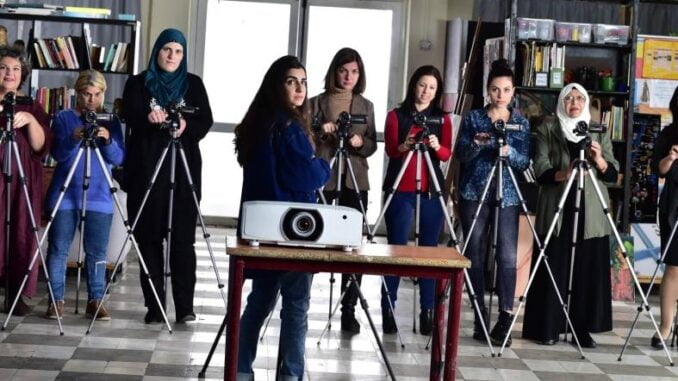
Similar to”karaoke”, One of his main competitors, Also the name of this movie is not in Hebrew, but a combination of English and Arabic. “Cinema” It's a cinema of course and”Sabaya”, Literally translated from Arabic – girls. As implied by its name, He is about a young Jewish filmmaker who leads a video photography workshop in the Hadera and the Triangle area.. Her students are eight women of different ages, All of them are municipal employees who came first of all for advanced study remuneration, And there are Jewish and Arab women in them.
Among the Jewish women there is a married woman with children, that she is literally a poster girl of the new Israeli bourgeoisie, But also bisexual that has never been institutionalized, A woman who suffered domestic violence and a woman of Commonwealth origin, who had to go back to live with her parents. Among the Arab women there are two who walk around wearing hijabs and two who don't, When one of them lives in a particularly patriarchal relationship – Despite all her pleas, Her spouse does not agree for her to issue a driver's license.

A dozen nominations for Ophir. of “Cinema Sabaya”(Photography : Ella Barak and Green Productions)
Through these eight women, The film deals with a variety of political and social issues.. One of them is the inequality between Jews and Arabs, that is revealed at the very beginning of the workshop. It turns out that despite the demographic composition, The classes will be conducted in Hebrew only. Young Arab participant protests and asks how it can be. Her older friend, An Arab woman who has already become accustomed to this distortion, Death “We know Hebrew and they don't know Arabic, So it will be in Hebrew. That's how it is”.
The film touches on inequality and other issues in several other places as well., But it does not pretend to form a mosaic of Israeli society, Does not seek to formulate a social document and does not flourish slogans about fraternity and coexistence. It was easy to fall into these traps, but “Cinema Sabaya” Sets himself much more complex goals. There is no longer a modern adaptation of “Lysistrata”. The women don't band together and go out of the workshop to make the world a better place.
Many Israeli films have moved on the tension between the public and private spheres, And the uniqueness of “Cinema Sabaya” that he does not leave the private sphere for a moment, And what happens in it does not necessarily have an impact on external reality. In this space we meet only the workshop facilitator and her students.. Men, If at all, They only emerge for a moment in their stories or in the exercises they film during their studies. In doing so, This Israeli work is similar to”Portrait of a girl on fire”, The best French film of the previous decade, that even in it they saw almost no male figures. Him, He, too, creates a kind of utopia, in which patriarchy does not exist, Or at least not physically present.

“Portrait of a girl on fire”, Israeli version. of “Cinema Sabaya”(Photography : Ella Barak and Green Productions)
Because the film takes place exclusively in this utopian space, where there is nothing beyond the teacher, For students and camcorders. It is clear that his subject is not “Israeli Society”. It deals with more universal issues.
One question is an ethical question. Does the workshop facilitator work out of a mission?, Or is she actually taking advantage of her students? At some point it turns out that she was so impressed by the materials that her students brought, Until she thought about using them for a film she made – Just like this movie, of course. The apprentices are not enthusiastic about the invasion of privacy, and refuse to do so. This is also where the question arises: Is there such a good story?, That it would be a waste not to tell it ever? To whom the experiences belong – For those who have experienced them, For those who have encountered them or for an audience that can enjoy them? Is art superior to the austerity of the individual?
Another question is unethical, rather, it is related to the power of the gaze. To say that”Cinema Sabaya” Demonstrates the power of the camera and the cinema it goes without saying. His move is more complex.
Throughout history and even today, Dominates the cinema “The male gaze”. Men stand behind the camera and photograph women, More than once in voyeurism. It is an illustration of the patriarchalism of society as a whole, And its continuation. The women in this movie turn the tables. They're the ones holding the camera. They're the ones who take pictures – themselves, or the men in their lives, who now contributes to being the ones who peek at their lives. The women in”Cinema Sabaya” They are not “Muse” Of any man. Both the authors and the subject. In this, too, it is similar to”Portrait of a girl on fire”, And for me that's the biggest compliment you can give (The difference is that in”Portrait of a girl on fire” The photographer was also a woman, And here it's a man – Itai Marom. Another commemoration of the fact that in the Israeli film industry in the first place there are almost no photographers).

No “Cinema Paradiso”. of “Cinema Sabaya”(Photography : Ella Barak and Green Productions)
This is Orit Fuchs-Rotem's first feature film. Her short films, “Eye fight” and”Hinoma”, Be excellent in themselves and create anticipation for what's to come, And it fulfilled the promise in the most satisfying way possible.
“Cinema Sabaya” Brilliant in both content and form. More than once, Films set behind closed doors turn out to be pale and monotonous. mouth, Formatting the image turns out to be a celebration of colors – red, Green and blue mix in a way that would not shame Almodovar.
Together with the casting director Emanuel Meyer, Asafa Fuchs-Rotem Ensemble of Actresses. The workshop facilitator is played by Dana Ivgi, who is nominated for the Ophir Prize and competes herself for her role in the”Savoy”. Her students are played by Joanna Said, who is also nominated for Ophir, and Liora Levy, Asil Farhat, Orit Samuel, Marlene Bajaly, Julia Tagil, Ruth Landau, Amal Murkus and Haula Al Haj’ Dibssi. Most of them are not very well-known stars, But they do an outstanding job, And the camera is good at getting the best out of their expressive faces.
Along most of the “Cinema Sabaya”, The heroines smile, But most of the time it's not just a smile of happiness. The camera here also illustrates what a spectrum of emotions there are in the human gaze and especially in the human smile – embarrassment, inquisitiveness, Acceptance and especially expectation.

Just one highlight moment, But what a moment! of “Cinema Sabaya”(Photography : Ella Barak and Green Productions)
Anyone who will expect tantrums, Crying and laughter will not get what he wants. It's a film that has only one climax moment, But it's charged with so much stress, Dramatic meaning and power, No extra moments needed. It is also a moment that reveals that the power of the camera and the cinematic illusion can be dangerous. “Cinema Sabaya” Is a film that is too complex and decent to claim that cinema is the path to redemption and nothing more.
Not everything is perfect in”Cinema Sabaya”. More than once it falls into stereotypes. It is true that he also talks about violent Jewish men, But ultimately the source of the greatest violence here comes from the Arab man. There is also a bit of folkloristic relish of Arabic music at the end, As if the role of Arab women in power is “Make happy” And add some color and dancing. These are all points to think about, But they don't nullify the value of the film., which is a masterpiece not only on a local scale, but also on an international scale.
Go to read the full article onWalla